More Than a True Crime Story: What The Crash
Can Teach Us About Teen Dating Violence
by Rachel Forsyth, Development Coordinator
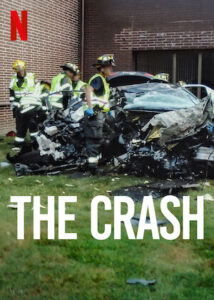
Netflix’s newest documentary, The Crash, has quickly become one of the most talked-about true crime films of the season. It paints the picture of Mackenzie Shirilla, her boyfriend Dominic “Dom” Russo, and their friend Davion Flanagan, ending in a tragedy that forever changed multiple families.
The Tragedy That Happened
In the early morning hours of July 31, 2022, 17-year-old Mackenzie Shirilla was driving a Toyota Camry in Strongsville, Ohio, with her boyfriend, 20-year-old Dominic Russo, and their friend, 19-year-old Davion Flanagan, as passengers.
The vehicle accelerated to approximately 100 mph before leaving the roadway and crashing into a commercial building. Russo and Flanagan were killed in the crash. Shirilla survived with serious injuries.
Investigators determined there was no evidence of braking before impact. Prosecutors argued that the crash was intentional, while the defense maintained it was a tragic accident caused by reckless driving.
After a bench trial in 2023, the judge found Shirilla guilty of two counts of murder, concluding that the evidence demonstrated she had deliberately driven the vehicle into the building. She was sentenced to two concurrent terms of 15 years to life in prison. Shirilla has continued to maintain that the crash was an accident, and her case has remained the subject of public discussion and appeals, especially now, with the documentary bringing the situation back into focus.
________
After my first watch of this documentary, I, like many viewers, found myself asking why. Why did a teenage relationship become so volatile? Weren’t there warning signs to those outside of the relationship, as it was happening? Could anyone have intervened?
Those questions are exactly why this story deserves to be discussed—not because it is shocking, but because it highlights conversations we need to be having with young people long before relationships reach a crisis.
At Anew, we spend every school year talking to thousands of middle and high school students about healthy relationships. One of the most important lessons we teach is this: Teen dating violence doesn’t usually begin with physical violence. It often begins with unhealthy patterns that become normalized.
When “Passion” Isn’t Healthy
Throughout The Crash, viewers learn that Mackenzie and Dom’s relationship was marked by repeated breakups, emotional highs and lows, jealousy, arguments, and reconciliation. Some friends and family described a relationship that seemed increasingly turbulent. Public testimony also described previous incidents involving threats, volatile arguments, and emotional conflict between the two.
Unfortunately, many teenagers mistake these behaviors for passion. They hear things like:
- “We fight because we love each other.”
- “We’re just obsessed with each other.”
- “Every couple breaks up and gets back together.”
- “They’re just jealous because they care.”
Movies, television, TikTok, and even friends sometimes reinforce the idea that dramatic relationships are romantic. But healthy love should never require fear, manipulation, or constant emotional instability.
Abuse Doesn’t Always Look the Way We Expect
One of the reasons this case has generated so much discussion is because it challenges stereotypes.
When people hear the words “dating violence,” many immediately picture an older adult male physically abusing a female partner. Reality is much more complicated.
Teen dating violence can involve:
- Emotional abuse
- Verbal abuse
- Digital abuse
- Threats
- Controlling behaviors
- Isolation
- Property destruction
- Physical violence
And it can happen regardless of gender.
Healthy relationships are built on respect—not fear.
Warning Signs We Should Never Ignore
Whether or not someone believes the relationship described in The Crash directly led to the tragedy, the documentary illustrates several warning signs that domestic violence professionals encourage people to recognize early.
These include:
- Constant breaking up and getting back together
- Extreme emotional reactions after conflict
- Threats made during arguments
- Feeling responsible for another person’s emotions
- Fear of how someone may react after a disagreement
- Increasing isolation from family or friends
- A relationship that feels exhausting instead of supportive
None of these signs automatically predict violence, but together, they tell us something important: The relationship needed help.
Why Prevention Matters
One of the hardest parts of watching documentaries like this is realizing that the warning signs often seem obvious in hindsight.
After tragedy, people naturally ask:
“Why didn’t anyone do something?”
The truth is that unhealthy relationships often develop gradually.
Young people may not recognize controlling behavior because they’ve never experienced a healthy relationship. Parents may assume the fighting is simply “teen drama. Friends may encourage couples to get back together after every breakup.
Adults may not realize that emotional abuse can be just as serious as physical violence. That’s why prevention education matters.
At Anew, our Community Education team spends the school year helping students recognize red flags before relationships become dangerous. We teach young people what respect looks like, how to communicate in healthy ways, how to establish boundaries, and where to seek help if something doesn’t feel right.
These conversations save lives—not because they predict tragedies like the one shown in The Crash, but because they help young people build healthier relationships from the very beginning.
The Conversation We Should Be Having
True crime documentaries often leave us focused on the verdict.
But perhaps the more important conversation is everything that happened before. What if someone had recognized the unhealthy dynamics earlier? What if more teenagers understood that love should never feel controlling, frightening, or emotionally exhausting? What if asking for help carried less stigma?
We’ll never know whether education alone could have changed this particular story.
What we do know is that every day, teenagers experience unhealthy relationships that never make national headlines. Those young people deserve the tools to recognize abuse before it escalates. Because the goal isn’t simply to understand tragedies after they happen. It’s to prevent the next one.

When the Laugh Track Fades: The Abuse You Don’t See
by Rachel Forsyth, Development Coordinator
Last month, I started watching Kevin Can F*** Himself, a show that had been out for a while but was new to me. The title alone pulled me in. What did Kevin possibly do to deserve that title? That question carried me through two seasons and sixteen episodes as I uncovered the answer.
The show is brilliantly constructed. Whenever Kevin is on screen, the lighting is bright, the colors are saturated, and the camera angles mimic a classic multi-cam sitcom. There’s even a laugh track. In that world, Kevin is portrayed as a lovable, goofy, slightly dimwitted husband getting into harmless antics with his buddies. His loyal circle—his father, his neighbor and best friend, and his best friend’s sister—laugh along with him. The banter is quick, the jokes are constant, and Kevin’s wife, Allison, is often the punchline. On the surface, she appears to take it in stride, even tossing a few jokes back.
But when Kevin leaves the room, the sitcom disappears.
The lighting dims. The colors fade. The laugh track is gone. What remains is Allison’s reality.


Kevin’s saturated sitcom world… vs. Allison’s muted drama.
Outside of Kevin’s glow, Allison is deeply unhappy. She is stuck in a loop of cooking, cleaning, and serving a husband who is neither grateful nor reciprocal. “Man-child” feels like too gentle a term. On their tenth anniversary, instead of an intimate dinner that Allison wished for, Kevin throws his annual “Anniversa-rager”—a party designed to avoid being alone with his wife. Even moments that should center their relationship are redirected to serve Kevin’s need for attention.
Allison dreams of something different. Since the beginning of her marriage, she has quietly saved money for a down payment on a new home—an escape from their small town and the life that has confined her. She spends afternoons looking at real estate listings, imagining a future that feels hopeful. When she finally shares her dream with Kevin, asking him to support the move, he reluctantly agrees. For the first time in a long time, Allison allows herself to feel optimism.
That hope is quickly shattered.
Patty, her neighbor, reveals that the savings Allison has relied on are gone. Kevin has been draining their joint account without her knowledge. When Allison confirms it for herself, the truth is devastating. The financial security she believed she had built—her path to freedom—never really existed. The betrayal breaks something in her. After a spiral of grief and anger, she lands on a shocking conclusion: the only way to be free of Kevin is to eliminate him entirely.
At first, her plan feels outrageous. But as the show unfolds, Kevin’s behavior becomes harder to dismiss as harmless comedy. Beneath the laugh track, he is manipulative, self-serving, and deeply controlling. He isolates Allison from meaningful friendships. He encourages others to belittle her. He sabotages her financial independence. In one episode, he brings home a dog that Allison quickly loves—only to abandon it when it no longer serves his purposes, without telling her. Time and again, Kevin prioritizes himself, leaving damage in his wake while maintaining the image of a lovable fool.
There is no physical violence between the couple depicted in the series, yet the abuse is unmistakable. It is emotional. It is financial. It is psychological. It is the kind that can be easily overlooked—especially when packaged in humor.
Allison does not always make wise choices. Trauma rarely produces tidy decision-making. When someone feels trapped, cornered, and unheard, their desperation can manifest in extreme ways. What the show captures so powerfully is that sense of isolation—of having no one fully on your side. And yet, it also shows growth. It shows how one genuine friendship can shift perspective, how validation can open the door to change, and how reclaiming autonomy is rarely a straight path.
While Kevin Can F*** Himself is fictional, its portrayal of domestic abuse feels uncomfortably real. The split-screen storytelling—the bright sitcom versus the muted drama—serves as a powerful metaphor. From one angle, everything looks fine. The husband is funny. The marriage is stable. The jokes land. But once the curtain drops and the audience laughter fades, a very different story emerges.
That duality reflects real life. Domestic violence is often invisible to outsiders. People curate how they present themselves publicly. They adapt when others are watching. What happens behind closed doors can remain hidden for years.
This show challenged me to think more deeply about perspective. About how we only ever see fragments of someone’s story. About how easy it is to mistake survival for sarcasm, or control for comedy.
I recommend Kevin Can F*** Himself to anyone willing to sit with that discomfort—to look beyond the laugh track and consider what might be happening when the lights dim.